Where I left off
Last post I introduced the project: revive Fury, Auran’s 2007 PvP MMO, from a single client install with no server and no source code. This post is the setup work. Going through the install file by file, writing a real plan, and then handing that plan to a second, more thorough AI pass to pull apart before I commit to anything. I expected the audit to tighten a few things. It rewrote the plan.
What I tried
First I went through the whole install and wrote down what’s actually there, in proper docs. An inventory, a target architecture, a roadmap, a glossary, a decisions log. Boring, but it’s the stuff that stops a long project turning into a pile of half-remembered guesses.
The shape of the install:
GOGame/ScriptFinalRelease/*.uis the compiled game code. UnrealScript compiles to bytecode rather than machine code, so a decompiler can turn it back into readable source.GOGame.uon its own is 9.5 MB and holds nearly 50,000 exported symbols. This is the good stuff.GOGame/Content/is 6.4 GB of packages, 38 maps, and 197 little.binfiles I’d written off as “some binary format, figure out later”.Binaries/has the client executables, a launcher, and a patcher.
Then I set the second pass loose on it with one instruction: assume I’ve missed something, and go looking in the parts I skipped. Mainly the raw executables.
What broke (or what I didn’t expect)
Two things, and they’re connected.
One: I was aiming at the wrong unknown. My plan treated “can Unreal Engine 3
even run a dedicated server from this old shipped code?” as the scary question.
The audit went digging in Fury.exe itself, just reading the text strings baked
into the binary, and the answer is basically yes. The server entry point is
compiled right into the client executable, next to the map editor, a database
layer, and the thing that stopped me: the entire configuration schema for
Auran’s server cluster. Section headings, setting names, port numbers, all of
it. [MATCHMAKING], [REALMMASTER], [BILLING], [LOGINS]. The name of every
server process and which port each one listened on.
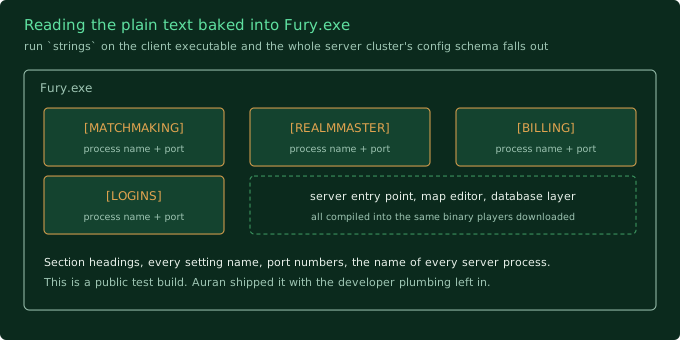
I thought I had a client. What I actually have is a client built from the same codebase as the servers, with most of the server-side scaffolding left in. That isn’t normal for a game you download. Usually that stuff gets stripped. This looks like a public test build, and Auran left the developer plumbing in.
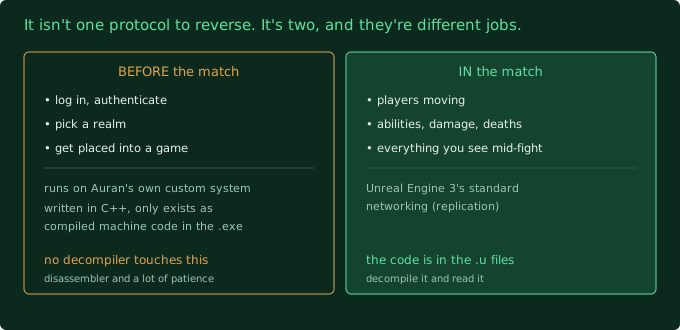
Two: there isn’t one protocol to reverse, there are two, and they’re very
different jobs. The in-match networking, players moving and fighting, uses
Unreal Engine 3’s standard system, and the code for it is in those .u files I
can decompile. That part is doable. But everything before the match, logging in,
picking a realm, getting placed into a game, runs on Auran’s own custom system.
It’s written in C++ and it only exists as compiled machine code inside the
executable. No decompiler touches that. Reversing it means a disassembler and a
lot of patience.
The saving grace: the launcher builds a plain text command line to start the
game, and it’s readable. It looks like a URL with options bolted on
(?login=...?realmurl=...). If I can write that line by hand and point the
realmurl part at a stub server of my own, I might get into a match without
touching the custom C++ layer at all. That one experiment is now the most
important thing in the project. If it works, the hard part becomes optional.
Oh, and those 197 .bin files I ignored? They’re the game’s entire data set.
Every ability, every piece of gear, every vendor, the admin command list, the
tutorial steps. In a typed table format that converts to plain text. I’d been
about to leave the whole game design on the floor.
What I learned
- Read the binary, not just the “readable” parts. I went straight for the
decompilable code and nearly missed that the executable itself is full of
plain-text evidence. Config keys, error messages, file paths, server names.
Running
stringson an .exe is a real research tool. - UE3 games run client and server from one codebase. Whether you’re playing or hosting is a launch option, not a different program. That’s why the server bits are sitting in my client.
- Get the plan audited before you fall in love with it. My ordering was backwards. I had weeks of code-reading scheduled before the afternoon of just running the thing and seeing what happens. Cheap experiments first.
Next up
Half a day of triage, all of it just running the shipped executables on a copy of the install and reading the logs:
- does the 2007 client even start on Windows 11
- does the dedicated-server mode start
- does the map editor open (this decides how far the “new content” dream can go)
- point the login at a socket I control and see the first bytes it sends
- and the big one: hand-build that launch URL and try to reach a match with the custom login layer bypassed
Whatever happens, that’s the next post.